Loading
Loading
Prophets never come to erase the past.
They come to illuminate it.
Thanks for reading! Subscribe for free to receive new posts and support my work.
They don’t destroy old foundations—they restore their vitality. They don’t burn books or dismantle rituals—they breathe life back into the words and forms that have gone stale with time. What they challenge is not tradition, but distortion.
Sree Sree Thakur Anukulchandra stood firmly in this lineage—not as a disruptor, but as a continuator. His presence was not a rejection of any Prophet, scripture, or culture, but a re-ignition of their original purpose. He came not to divide, but to reconnect the fragmented truths that once guided humanity in harmony.
He often repeated a simple yet radical truth:
“To fulfill and not to destroy—this is the dharma of the Prophet.”
This was not a slogan—it was a stance. One that views history not as a sequence of rival faiths, but as a stream of evolving fulfillment. Where some see contradiction between Veda and Gospel, or between the silent Buddha and the fiery Quran, Thakur saw continuity. Where others fought for supremacy, he called for synthesis.
In his vision, every tradition—if traced to its root—is an expression of the same longing: the longing to become whole. Every scripture is a layered attempt to articulate that longing. And every Prophet, in his time, gave it form.
But over time, forms harden. Principles get replaced by procedures. Inspiration becomes instruction. Living fire turns into static formula. That’s when re-illumination becomes necessary—not to negate the form, but to recover the flame inside it.
Thakur once warned:
“No religion is false. But if you hold on to your Prophet and forget his principles, then you only hold on to a corpse.”
His test for truth was practical and uncompromising:
Does this path help you evolve?
Does it deepen your love and expand your service?
Does it align you with the rhythm of becoming?
If yes, it is Dharma. If not, it needs adjustment—not abandonment, but recalibration.
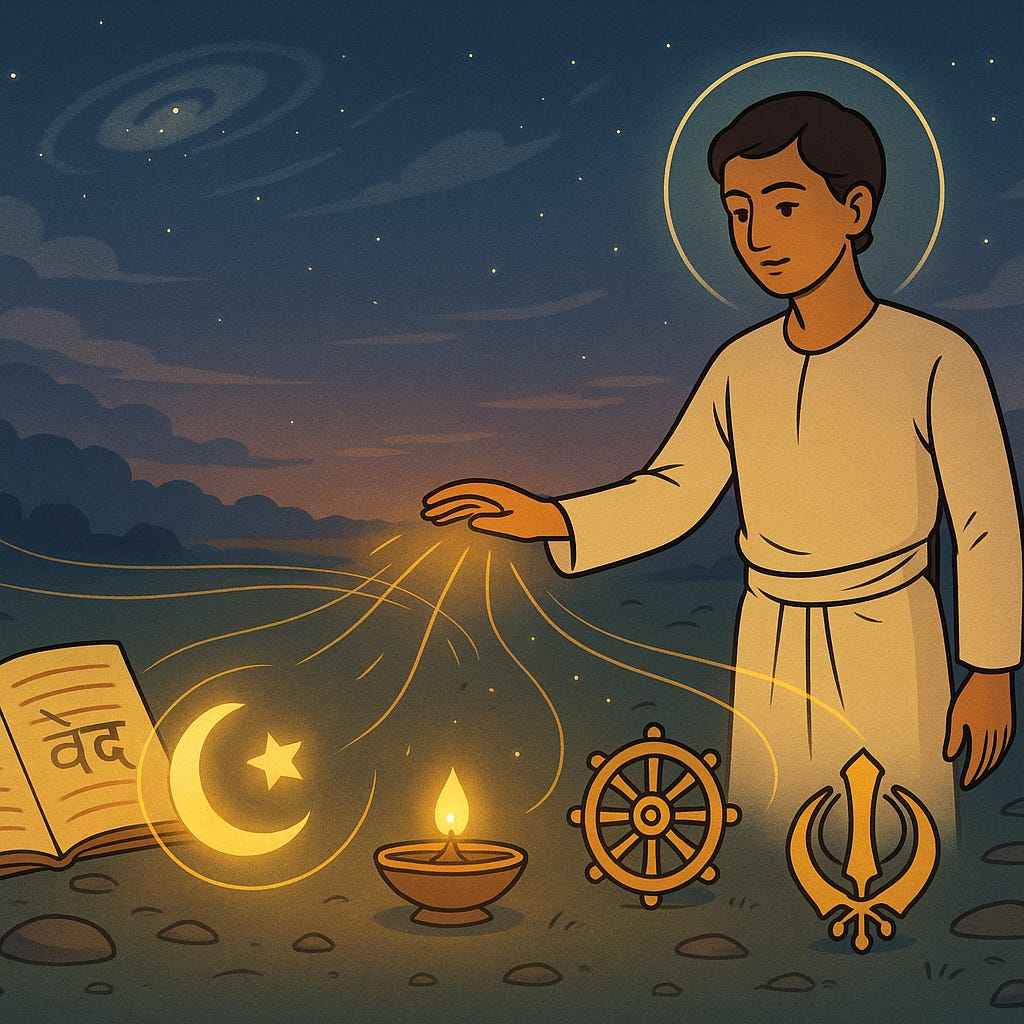
This is the essence of re-illumination. Just as one light can shine through stained glass in countless colors, the eternal truth has expressed itself through countless traditions. Vedic sacrifice, Buddhist mindfulness, Christian mercy, Islamic surrender, Sikh courage—each is a facet of the same radiant core.
But when these facets become walls, when unity is lost to uniformity, when living truth is reduced to fixed dogma—a Prophet must rise again. Not to tear down what came before, but to restore its direction.
That’s what Sree Sree Thakur did.
He clarified that sacrifice isn’t about blood—it’s about selfless action.
That Naam isn’t just a chant—it’s the tuning of one’s being to a divine vibration.
That love isn’t soft emotion—it’s disciplined care.
That religion isn’t about belief systems—it’s about becoming who you’re meant to be.
He didn’t discard rituals—he made them speak again.
He didn’t reject tradition—he infused it with relevance.
He didn’t oppose religions—he opposed whatever obstructs the growth of the soul.
“I do not oppose any religion,” he said,
“but I oppose whatever obstructs the becoming of man.”
To Thakur, Dharma was never about fixed identity—it was about function. It was not the rite, but the result that mattered. In temples, churches, mosques, and gurdwaras, he saw the same thread—the same longing dressed in different robes.
He took that thread, rewove it into a living path, and offered it back to the world—not as a banner to fight under, but as a rope to climb.
This is the heart of re-illumination:
To clean the mirror, not throw it away.
To wash the dust off the lamp—not break it.
To reclaim the living from the lifeless—and begin, again, to become.
Thanks for reading! Subscribe for free to receive new posts and support my work.
New videos in this category will appear here after the next sync.