
Loading
Loading
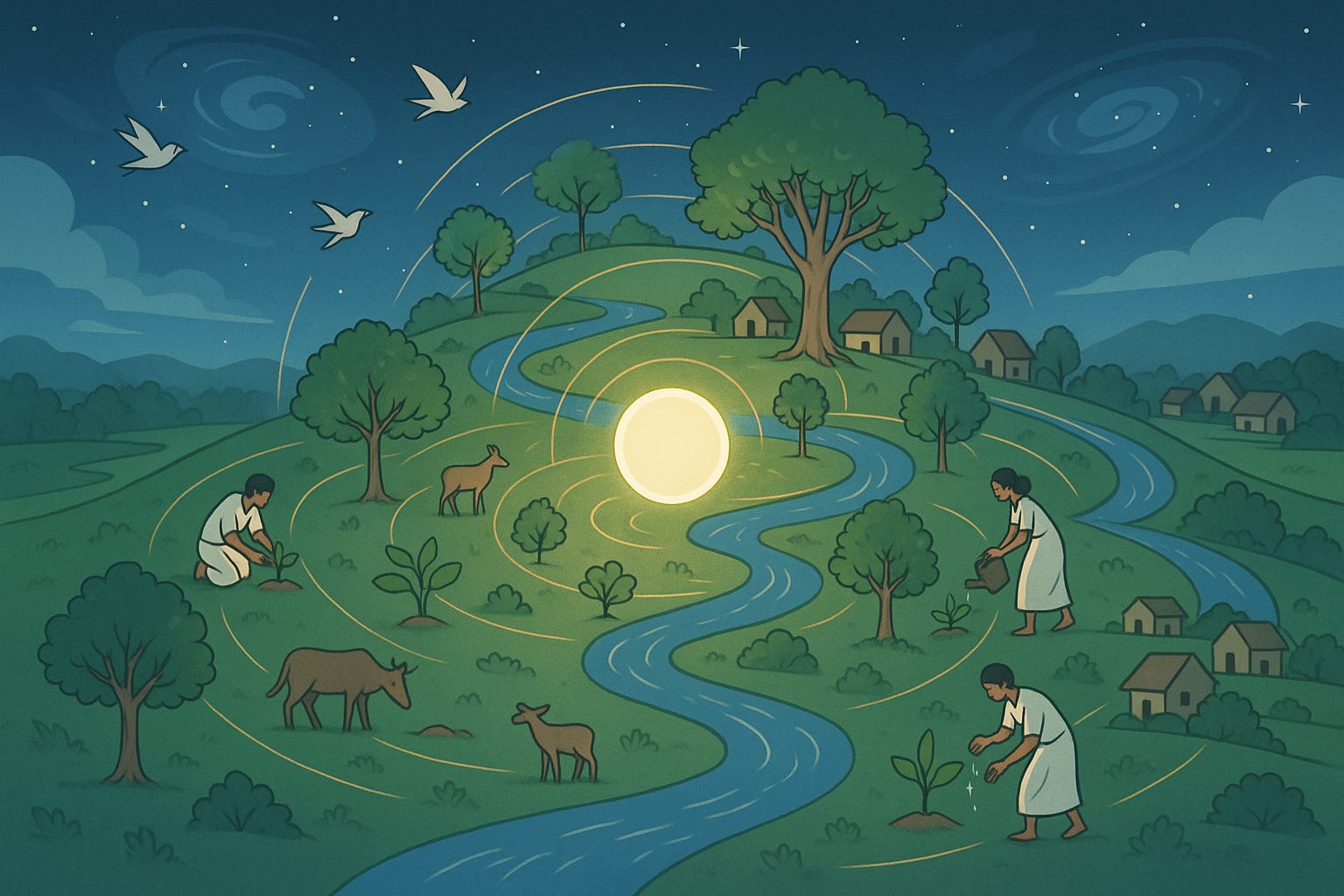
There is a law that predates every scripture, outlasts every ideology, and overrides every force of coercion. It’s not written in books, but inscribed in the structure of life itself.
It is the law of fulfillment.
Every atom moves with an implicit desire to become what it’s meant to be. Every living cell seeks growth. Every human soul carries a quiet but persistent hunger—not just to survive, but to become. To unfold, to express, to reach the full measure of its essence.
This isn’t sentiment. It’s biology. It’s existence itself.
The flower must bloom.
The seed must sprout.
The self must find its Source.
But that leads to the deeper question: How?
How does this innate drive find direction? What prevents the process of becoming from turning into confusion, or even destruction?
Here, the concept of the Prophet enters—not as a figure of religious tradition, but as an ontological necessity. A structural feature of reality. A principle built into the very architecture of growth.
Sree Sree Thakur Anukulchandra put it succinctly:
“The Ideal—he who is the living manifestation of existential principles—alone can integrate, guide, and fulfill man and society.”
Thanks for reading! Subscribe for free to receive new posts and support my work.
A Prophet, then, is not just a teacher or a spiritual leader. He is fulfillment personified. He doesn’t merely preach values—he embodies them. He is the junction where cosmic principles take on human shape. He doesn’t represent an escape from life—he reveals its design.
Just as the sun doesn’t simply exist but organizes all life around its light, the Prophet doesn’t merely exist. He orders our growth. Without that central organizing force, dharma becomes rhetoric, rituals decay into habit, and we lose ourselves in the noise of survival.
Thakur clarified it powerfully:
“All principles are true only in relation to the Ideal who lives them out.”
In other words, the principle alone is not enough. It must be seen, lived, and proven in a human being. Only then does it gain the authority to guide others.
To follow a Prophet is not submission—it’s alignment. It’s not about giving up freedom, but about anchoring it to something real. Just as rivers flow to the ocean not out of compulsion, but because it is their natural end, so too does human life find its natural fulfillment in aligning with the Fulfilled.
The Prophet is not beyond human—he is its highest expression. He is the peak of the wave, not detached from the sea, but carrying its full energy and rhythm to shore.
That’s why fulfillment is not a luxury or a private goal. It is the law of being. When we resist it, we fracture. When we align with it, we ascend. This isn’t idealism—it’s clarity. A society without a living axis becomes a battleground of ideologies, disintegrating under the weight of its own contradictions.
As Thakur’s message reminds us:
“To fulfill and not to destroy—this is the dharma of the Prophet.”
The Prophet is not ornamental. He is structural.
Not a guru of comfort, but the pulse of evolution.
Not an escape hatch from life, but the shape it must take to grow.
He doesn’t ask for belief. He demands becoming.
He doesn’t promise heaven. He reclaims the earth.
Through him, fulfillment is no longer a distant hope—it becomes the very law we were meant to live by.
New videos in this category will appear here after the next sync.


